How I Extract Honey
How I Extract Honey
Everyone asks the same question when they find out I keep bees: how do you actually get the honey out? Here is how it works, from frame to jar.
This year one of my vertical Langstroth hives in Watertown did well enough that I pulled a honey super off of it and extracted ten frames of honey. That is a real harvest, and going through the process again reminded me how much people enjoy seeing how it is done. So let me walk you through it.
Step one: pull the honey
Honey lives on frames inside the hive. When the bees have filled the comb and capped it (sealed each cell with a thin layer of wax) the honey is ripe and ready. That capping is the bees' signal that the moisture content is right and the honey will keep. You want to harvest capped frames; uncapped honey can be too wet and may ferment.
From that one productive vertical hive, I had a full super of frames ready to come off.
Step two: uncap the comb
Before honey can come out, you have to remove that wax capping. This is the uncapping step — you run a heated knife, a capping scratcher, or a special uncapping tool across the face of the comb to slice open the sealed cells and expose the honey underneath. You do both sides of each frame. I like to use a combination of a knife and scratcher.
The wax cappings you remove are not waste, either. They are clean, high-quality beeswax, and they go straight into my supply for soap and lip balm. Nothing gets thrown away.
Step three: spin it out
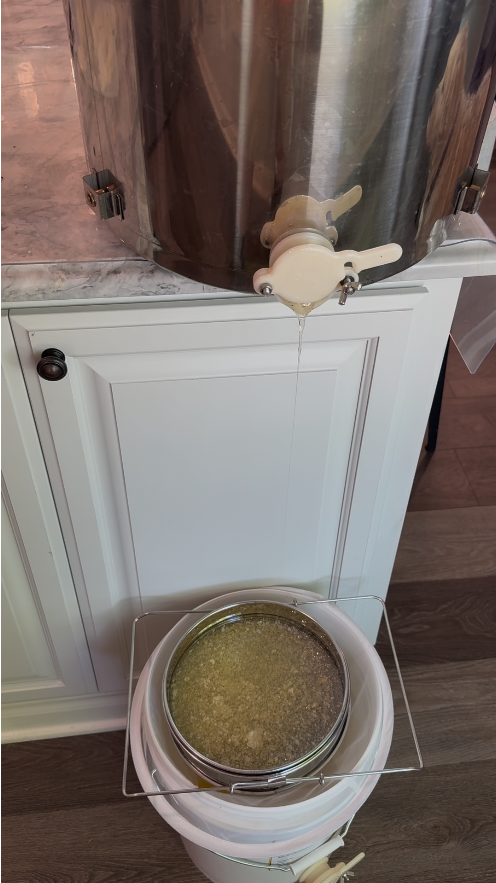
The uncapped frames go into an extractor, a drum that holds the frames and spins them fast. Centrifugal force flings the honey out of the comb and onto the walls of the drum, where it runs down to the bottom. The beauty of an extractor is that it empties the comb without destroying it, so those frames go back to the bees to be refilled. That saves the colony an enormous amount of work rebuilding wax.
Step four: filter and bottle
The honey drains out of the extractor and gets strained to remove bits of wax and the occasional stray debris. Then it goes into jars. That is it! Raw honey, straight from the hive, nothing added and nothing cooked out of it.
Ten frames does not sound like much until you are the one turning the crank and watching it flow. There is something deeply satisfying about it, the payoff for a whole season of the bees' work and mine.
Why the process matters to me
I keep my extraction simple and clean because it fits the bigger commitment I have made this year: natural, treatment-free beekeeping. I want the honey in the jar to be exactly what the bees made, and I want the wax I set aside to be clean enough to put in products that go on your skin. The extraction step is where all of that either stays honest or gets compromised, so I keep it honest.
More on the treatment-free side of things in another post. For now, just know that when you open a jar of Bloom-N-Hive honey, you are getting the same thing that came out of that spinning drum.
— Craig, Bloom-N-Hive