Two Apiaries, Six Hives
A year ago I had two backyard hives and a vague plan. This year I am running two apiaries, eight hives, multiple bee breeds, and a running experiment in learning to leave my bees alone.
Here is where things actually stand right now…..
The setup
I keep bees in two locations.
My backyard apiary has two Layens hives, the deep, insulated horizontal hives I wrote about last time.
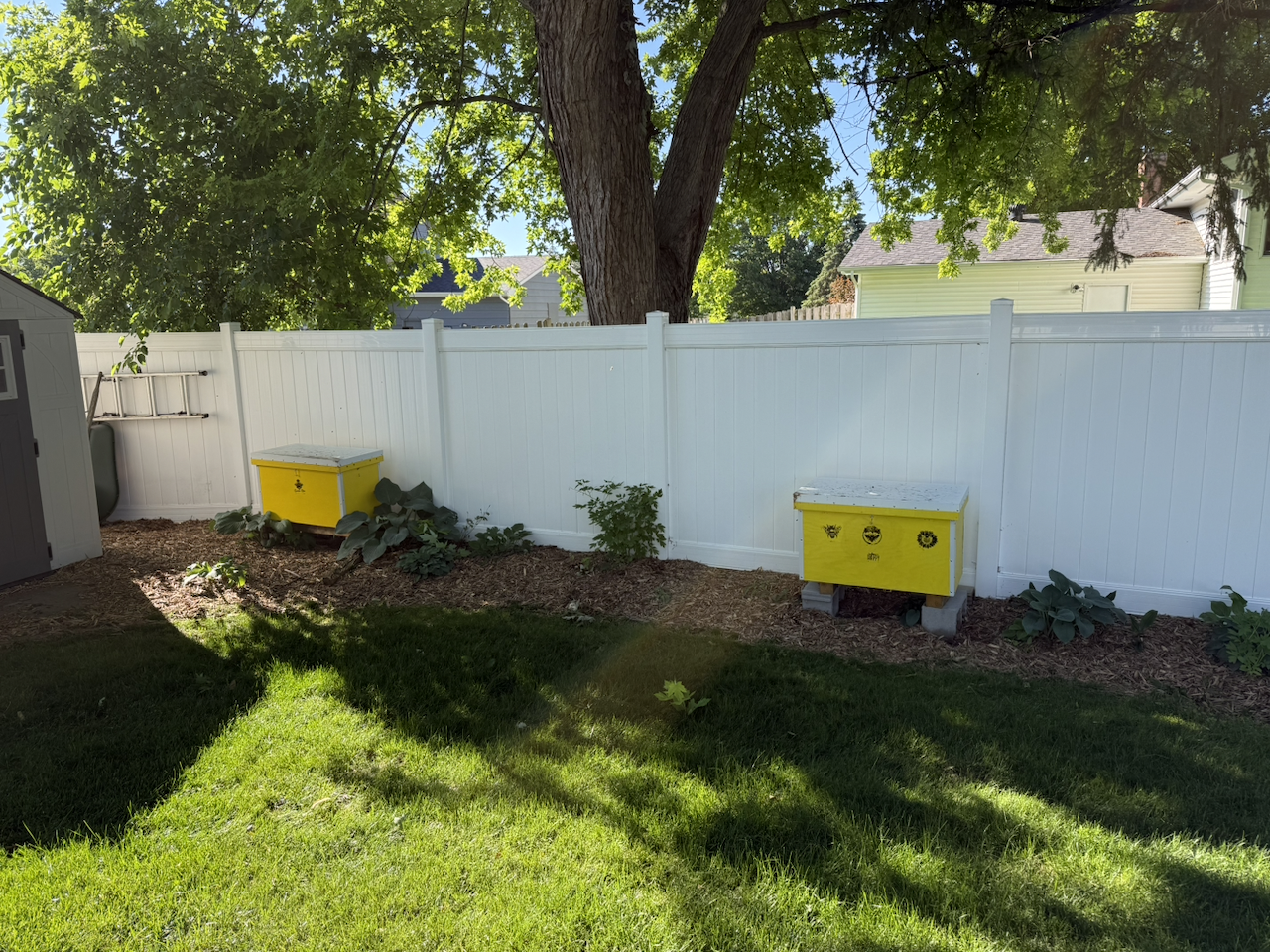
Backyard apiary
This is my apiary in my backyard. Again, under a large shade tree to keep it cooler in the summer
My Watertown apiary is the bigger operation. I started the season out there with two vertical Langstroth hives and two Layens hives. Since then I have done a couple of splits, which brought me to four Layens hives plus the two verticals six hives in Watertown.
Add it up and I am at eight hives across two apiaries. That is a long way from the two hive backyard apiary I planned as a gardening experiment.
Testing everything at once
Because I am still learning, I am deliberately running comparisons rather than betting on one approach.
On bee breeds, I bought Buckfast and Carniolan bees from two different suppliers this year. When I needed to requeen, and when I did a split, I brought in Caucasian queens, partly to see whether they behave any differently for me. Different genetics, same conditions, side by side.
On hive construction, I am comparing two very different Layens builds. Some are the wool-fiber-insulated hives I bought from Dr. Leo through horizontalhive.com. Others are heavier hives built from thick pine, essentially two-by-ten construction. I genuinely do not know yet which will do better through a Minnesota winter, so I am running both and letting the results tell me.
The hard part: leaving them alone
Natural beekeeping asks you to inspect early, then step back and let the bees work. I believe in that. Doing it is another matter.
I have been in and out of my Layens hives quite a bit this year, opening up the end, checking how many bees I have, generally satisfying my curiosity. And I think all that fussing may have cost me a queen in at least one hive. That is a hard lesson to sit with, because it was self-inflicted.
So I am making myself slow down. Peek less. Trust the bees more. The whole point of the natural approach is that the colony usually knows what it is doing better than I do, and every time I open the hive I introduce a little disruption. The discipline of doing less is a real beekeeping skill, and I am still building it.
Thank you, Jenny
None of the Watertown apiary would exist without Jenny, my brothers gal, and my landlord out there. She has been gracious enough to host me and my bees on her farm, and I could not be more grateful for it. Having that space is what let this hobby grow from a single backyard hive into a real operation with room to experiment.
Thank you, Jenny. I owe you some honey and I intend to pay up.
— Craig, Bloom-N-Hive